 Writers call Russia's Chukotka Region "the shore of two oceans." Indeed,
Chukotka stretches from the Arctic Ocean in the north to the Pacific Oсean
in the east, covering 700,000 square kilometers, an area larger than France.
Chukotka is also the Russian territory closest to the US, separated from Alaska
by only the narrow Bering Strait.
Writers call Russia's Chukotka Region "the shore of two oceans." Indeed,
Chukotka stretches from the Arctic Ocean in the north to the Pacific Oсean
in the east, covering 700,000 square kilometers, an area larger than France.
Chukotka is also the Russian territory closest to the US, separated from Alaska
by only the narrow Bering Strait.
Russian named Chukotka after the most numerous population of indigenous peoples in the region, the Chukchi. "Chukcha" means "having many deer" in the local Chukchi language.
Despite its size, travel from Moscow to Chukotka is relatively expensive and inconvenient. Flights cost 20,000 rubles and are only available once a week from two of Moscow’s airports: from Domodedovo Airport to the city of Pevek or from Vnukovo Airport to Anadyr. Flights take nine hours in part because the small planes used for the flights must stop midway to refuel.
Upon landing in Chukotka, surprises await the traveler. As writer Oleg Kuvaev put it, "your flight finishes on a different planet, not in the one where it began. You will encounter cool and humid air, a black and yellow landscape if you arrived in summer, and severe white bareness if you arrived in winter. There are no trees, only mountains and tundra, terribly naked."
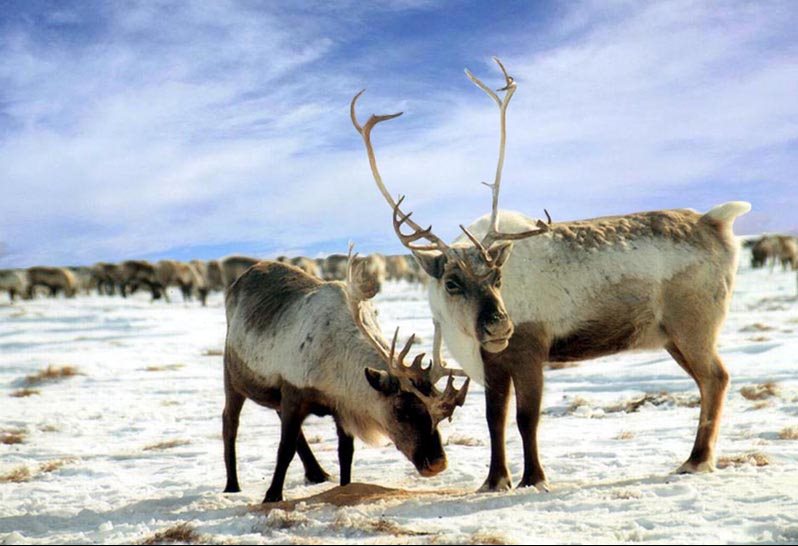
However, Chukotka does have some diversity in its wide expanse. Western Chukotka is tundra, and the southern part is classed as forest-tundra. Thousands of deer live here, and one can also encounter both brown bears and polar bears, arctic ground squirrels, and polar foxes. In the summer, the tundra blossoms into a bright picturesque carpet of flowers, mushrooms, and delicious blueberries and cloudberries. Ducks and geese live on the shores of rivers and lakes rich in salmon.
If you happen to visit Chukotka in winter, you may encounter the particularly harsh "southern blizzard,” which can swirl for two or three days with wind speeds of up to 200 meters per second. Unsurpisingly, life during the southern blizzards basically stops: Schools and many businesses close as people stay in their homes.
Chukotka also has many natural resources. In the 1930s major tin deposits were discovered there, and in the 1950s, gold deposits were found. The government of the USSR established GULAGs to extract it and later offered "a long ruble" (a slang term for the high salaries, which were up to three times the national average) to those willing to voluntarily move there. Towns and settlements grew rapidly in Chukotka, although the area has never been densely populated. The regional population reached a still-sparse peak of 164,000 in 1989. By contrast, the population of France is about 65 million.
With the fall of the USSR and the end of Soviet subsidies, local industries collapsed in the early 1990s as current extraction processes proved unprofitable in the new market economy. The area was also not immune to corporate crime and corruption during those "wild east" days: in one instance a major tin plant near the town of Pevek was closed when the director fled with the money that had been allocated to convert the plant to more profitable gold processing.
As plants and mines closed, settlements evaporated and residents moved to Central Russia. Currently, Chukotka has only two population centers - Anadyr (the capital, population 11,000) and Pevek (a sea port on the Eastern Arctic coast, population 4,000) as well as six small settlements that server as district centers and several "national villages" where 28 percent of the population (indigenous peoples such as the Chukchi and the Eskimo) reside. The regional population now totals 54,000. Gold mining, is now performed mostly by migrant workers from the Ukraine and Moldova working gold cooperatives. Th mining season runs from May to September.
However, the economy and living conditions in Chukotka after 1989 have remained poor. Some improvements were made after billionaire tycoon Roman Abramovich became the governor of the region in 2000 and funneled billions of his own money into developing the region’s infrastructure. Salaries for state-sponsored industries have resumed and specialists from central Russia were brought in for regional administration and projects to solve the region’s economic problems. However, the situation is still far from ideal and traditional local industries such as reindeer-herding are slowly dying. Because of the region’s climatic and economic conditions, much of the education there in recent years has taken place in special boarding schools which serve students from a wide geographic area. These young people, raised in population centers and often with technology, can now hardly imagine themselves living in the tundra in a yaranga (a traditional round tent of deer skin) where in winter temperatures even inside the structure can be below zero.
Economic development is further hindered by the fact that there are no roads to transport cargo directly from Chukotka to Central Russia. As for reindeer-breeding and walrus hunting, such industries have never been profitable and serve primarily as methods of subsistence living for individual families. The region does have good potential for eco-tourism and extreme tourism, but again, transport is undeveloped, as is the hospitality industry. In addition, visitors - Russians and foreigners alike - must have an official invitation inorder to enter the region. Therefore, it is generally adviseable to see Chukotka through the services of tour agency, a tour group recently opened, in part, by Russian scientists for the purposes of eco-devlopment and tourism in Russia's regions.
Despite the hardships in getting there, tourists brave enough to do it rarely regret their decision. This region remains in one's memory forever. One can enjoy traditional sports such as dogsled racing, kayak racing, and fishing (for which there are festivals in spring). In summer, tourists can ride on the ice-breakers and step off on an iceberg. Sea life in summer draws nature lovers to see the unique bird colony on the rocky islands just of the shore, and to see seals and flocks of sea-gulls on the way. For lovers of "white nights," there is daylight twenty-four hours a day in the summer, and in the winter there the northern lights flash in the near-endless night like bright rainbow ribbons.
For city lovers, Anadyr has become a modern city with supermarkets, restaurants and beautiful apartment buildings painted in bright colors. Most national villages have also considerably improved as the local government has built new housing with modern facilities there.
In wide open expanses of Chukotka, there are many places to see, much for nature-lovers to do, and many unforgettable impressions.
http://www.sras.org