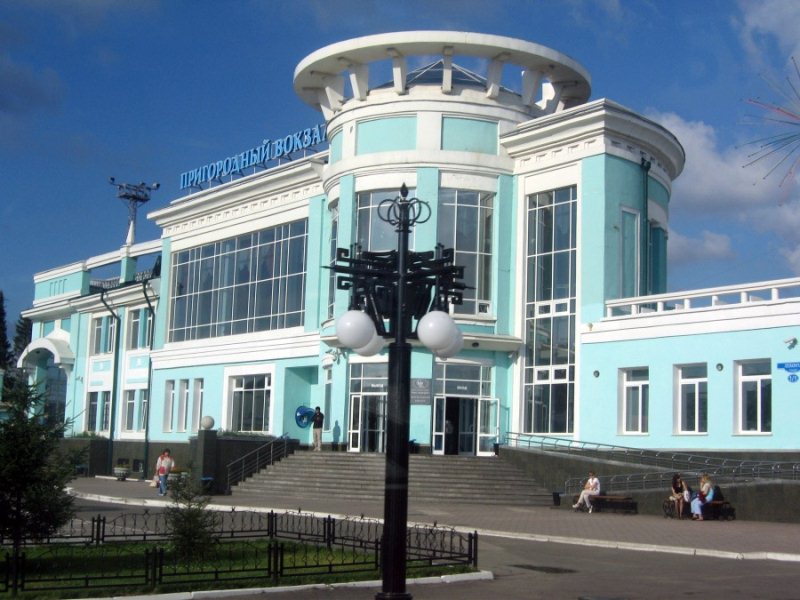
 Standing on the banks of
two rivers, the Om River and the Irtysh River, the City of Omsk is located in
the south of Western Siberia. Omsk is almost 290 years old. In terms of world
history, it is young, but it has accumulated many traditions and is well-known
for its famous history. Omsk is home to an oil industry, precise mechanical
engineering, and the food and textile industries.
Standing on the banks of
two rivers, the Om River and the Irtysh River, the City of Omsk is located in
the south of Western Siberia. Omsk is almost 290 years old. In terms of world
history, it is young, but it has accumulated many traditions and is well-known
for its famous history. Omsk is home to an oil industry, precise mechanical
engineering, and the food and textile industries.
A beautiful site was chosen for the new fortress by the guardsman of Peter the Great Ivan Buchholz, when in spring of 1716 he and his detachment made a landing on the shore of the River Irtysh in the place where this powerful Siberian river takes the quiet Om into its broad riverbed. According to the edict of the Tsar Peter the Great and his deputy in Siberia, Prince Gagarin, pioneers erected the fortification here to guard the southern Russian borders. Thus the town was founded.
In 1894 when the railroad came, Omsk was referred to as the Gates of Siberia. The Great Siberian rail increased the local economy by connecting Omsk with Moscow, St. Petersburg and the Far East. Representatives of famous Russian and foreign companies came to the far Siberian town. As a result, Omsk begain intensive construction of impressive buildings: banks, shops, apartments and offices.
Presently the Omsk Region occupies a territory of 1.41 mil. square km. and has a population of 2.127 million people, 1.15 million of them living in the City of Omsk.
Omsk is a theatrical city. It is home to five state and three municipal theaters, all-in-all seating 1500. The city has great scientific potential. The names of academician and honorary citizen of Omsk V. Bisyarina, academician N. Milachshenko, Honorable Science and Techniques Workers K. Artemiev, T. Alexeeva, D. Krinitsin, V. Mezentsev, K. Tolmachev, and social anthropologist I. Tomilov are well-known in Russia and abroad. There are more than 42 Institutions of Higher Education, including 17 that are state accredited.
www.sras.org