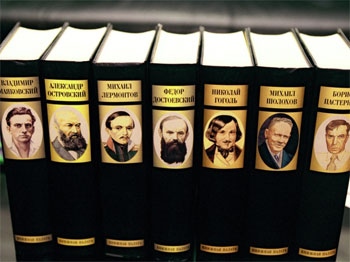
 Russian literature in the last half of the nineteenth
century provided an artistic medium for the discussion of political and
social issues that could not be addressed directly because of government
restrictions. The writers of this period
shared important qualities: great attention to realistic, detailed
descriptions
of everyday Russian life: the lifting of the taboo on describing the
unattractive side of life; and a satirical altitude toward routines.
Although varying
widely in style, subject matter, and viewpoint, these
writers stimulated government
bureaucrats, nobles, and intellectuals to think about important social
issues. This period of literature, which became known as
the Age of Realism,
lasted from about mid-century to 1905. The literature of
the Age of Realism
owed a great debt to three authors and to a literary
critic of the preceding half century:
Aleksandr Pushkin, Mikhail Lermontov, Nikolai Gogol, and Vissarion
Belinsky. These figures set a pattern for language, subject matter, and
narrative techniques, which before 1830 had been very
poorly developed. The
critic Belinsky became the patron saint of the radical
intelligentsia throughout
the century.
Russian literature in the last half of the nineteenth
century provided an artistic medium for the discussion of political and
social issues that could not be addressed directly because of government
restrictions. The writers of this period
shared important qualities: great attention to realistic, detailed
descriptions
of everyday Russian life: the lifting of the taboo on describing the
unattractive side of life; and a satirical altitude toward routines.
Although varying
widely in style, subject matter, and viewpoint, these
writers stimulated government
bureaucrats, nobles, and intellectuals to think about important social
issues. This period of literature, which became known as
the Age of Realism,
lasted from about mid-century to 1905. The literature of
the Age of Realism
owed a great debt to three authors and to a literary
critic of the preceding half century:
Aleksandr Pushkin, Mikhail Lermontov, Nikolai Gogol, and Vissarion
Belinsky. These figures set a pattern for language, subject matter, and
narrative techniques, which before 1830 had been very
poorly developed. The
critic Belinsky became the patron saint of the radical
intelligentsia throughout
the century.
Ivan Turgenev was successful at integrating social concerns with true literary art. His «Hunter's Sketches» and «Fathers and Sons» portrayed Russia's problems with great realism and with enough artistry that these works have survived as classics. Many writers of the period did not aim for social commentary, but the realism of their portrayals nevertheless drew comment from radical critics. Such writers included the novelist Ivan Goncharov, whose «Oblomov» is a very negative portrayal of the provincial gentry, and the dramatist Aleksandr Ostrovsky, whose plays uniformly condemned the bourgeoisie.
Above all the other writers stand two: Lev Tolstoy and Fedor Dostoevsky, the greatest talents of the age. Their realistic style transcended immediate social issues and explored universal issues such as morality and the nature of life itself. Although Dostoevsky was sometimes drawn into polemical satire, both writers kept the main body of their work above the dominant social and political preoccupations of the 1860s and 1870s. Tolstoy's «War and Peace» and «Anna Karenina» and Dostoievsky's «Crime and Punishment» and «The Brothers Karamazov» have endured as genuine classics because they drew the best from the Russian realistic heritage while focusing on broad human questions. Although Tolstoy continued to write into the twentieth century, he rejected his earlier style and never again reached the level of his greatest works.
The literary careers of Tolstoy, Dostoevsky, and Turgenev had all ended by 1881. Anton Chekhov, the major literary figure in the last decades of the nineteenth century, contributed in two genres: short stories and drama. Chekhov, a realist who examined not society as a whole but the defects of individuals, produced a large volume of sometimes tragic, sometimes comic, short stories and several outstanding plays, including «The Cherry Orchard», a dramatic chronicling of the decay of a Russian aristocratic family.