 Peterhof, once the luxurious country residence of
Russian emperors just outside St. Petersburg and now a world-renowned
museum and nature preserve dubbed the capital of fountains, has held a
festival named Samson after the most famous of the fountains. For some
time now the Peterhof Museum has been reviving festival traditions of the
capital of the Russian Empire. The Grand Cascade in a mystical glow from
the gold of its statues, the melodious gurgling of the falling water and
the cool breeze from the Gulf of Finland all set the tone of the
festivities. Shows must combine the majesty of Baroque, the elegance and
intellectual quality of the days of Peter the Great just as they did
centuries ago.
Peterhof, once the luxurious country residence of
Russian emperors just outside St. Petersburg and now a world-renowned
museum and nature preserve dubbed the capital of fountains, has held a
festival named Samson after the most famous of the fountains. For some
time now the Peterhof Museum has been reviving festival traditions of the
capital of the Russian Empire. The Grand Cascade in a mystical glow from
the gold of its statues, the melodious gurgling of the falling water and
the cool breeze from the Gulf of Finland all set the tone of the
festivities. Shows must combine the majesty of Baroque, the elegance and
intellectual quality of the days of Peter the Great just as they did
centuries ago.
The parks, fountains and cascades in Peterhof were created in Russia's heyday, when architecture was dominated by Baroque, Peter the Great opened 'a window on Europe', new aesthetics of merrymaking evolved, and new traditions emerged. A great devotee of fountains and fireworks, the Emperor chose this site for a country residence. When he examined the locality of St. Petersburg, he found several bodies of water fed by springs. The principles of water supply he elaborated at the time remain in use to this day, bearing testimony to his talent and learning. The Peterhof fountain system is such that it never dries up even in the most severe drought.
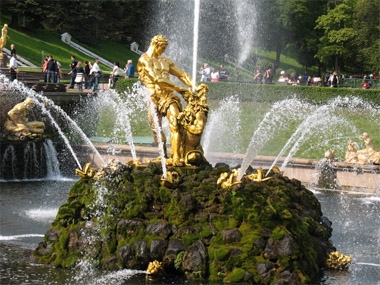
The Samson Fountain is the main fountain of the Grand Cascade. Its jet rises 21 meters. The fountain was erected in 1735 to commemorate the 25th anniversary of Russian victory over Sweden in the battle at Poltava. This landmark event of the Northern War took place on the day of St. Sampson the Hospitable. The saint's name similar to Samson, the name of a character in the Old Testament, prompted the idea of depicting the battle allegorically in the form of Samson triumphing over a lion, the animal that features in Sweden's coat of arms. The sculpture was created by Bartolomeo Carlo Rastrelli. It depicts the most dramatic moment of the struggle. The lion has risen on its hind paws and dug its claws into Samson's hip. But Samson holds the beast's jaws in an iron grip. Water spurts out of the lion's mouth. Samson's muscles are tensed, veins protruding. Eight dolphins, blowing bow-shaped jets that form a sparkling wreath frolic at Samson's feet, while four lions, representing the four cardinal points, peep out from niches in the cliff to watch the struggle as • streams of water leap from their mouths.
Unfortunately, the fountain group of Samson tearing asunder the maw of a lion was cast in lead and within a decade needed repairs. By the end of the 18th century it had to be replaced. So in 1802 it was cast in bronze and erected on a pedestal of granite slabs. During World War II Peterhof was occupied by Nazi troops and the sculpture got lost without trace, together with the three; other largest sculptures of the Grand Cascade. In August of 1946, however, Peterhof celebrated the rebirth of its fountains, and the following year saw the mighty figure of Samson on its former site. The sculpture was restored according to surviving prewar photos. The Samson holiday is now marked every year on the day when the statue returned to Peterhof.
Though the holiday comes at the end of August and is marked as a kind of farewell to summer, the fountains continue to operate, weather permitting, until mid-October. The splendor of the royal residence attracts great numbers of people from all over the world. This year Peterhof has welcomed nearly four million visitors, half of them from abroad.
Natalya Grigoryeva
(Moscow today and tomorrow. October. 2002)