"If I were told that what I shall write will be read... by the children of today and that they will weep and smile over it and fall in love with life, I would devote all my life and strength to it." - Leo Tolstoy
 Leo
Tolstoy's estate, "Yasnaya Polyana," lies just 30 minutes by car from Tula, a
town whose citizens and children the author of War and Peace dearly loved. He
spent much of his life there writing and telling stories. His grave, unmarked
but oft-visited lies near his estate, at the fabled location of the "Green
Stick." In childhood, Nikolai Tolstoy told his younger brother Leo that he had
written the secret to world peace on a green stick and had hidden it along a
road in the woods. When the stick was found, it would usher an era of
unprecedented brotherhood to earth. The story while fiction did place the
younger brother on the road to literary greatness and philosophical
contemplation.
Leo
Tolstoy's estate, "Yasnaya Polyana," lies just 30 minutes by car from Tula, a
town whose citizens and children the author of War and Peace dearly loved. He
spent much of his life there writing and telling stories. His grave, unmarked
but oft-visited lies near his estate, at the fabled location of the "Green
Stick." In childhood, Nikolai Tolstoy told his younger brother Leo that he had
written the secret to world peace on a green stick and had hidden it along a
road in the woods. When the stick was found, it would usher an era of
unprecedented brotherhood to earth. The story while fiction did place the
younger brother on the road to literary greatness and philosophical
contemplation.
Tula remains to this day a city of curious storytellers, whose phonetic dialect and old-style literary vocabulary sets them apart from most of Russia. Another local favorite revels the city's other boast, that of mechanical ingenuity. Levsha, a cross-eyed, left-handed smith is boasted to have out-witted his English contemporaries by recreating their invention: a mechanical flea. Levsha improved on the flea by making tiny shoes for it and even writing his name on one of the flea's toenails. The punch line: Levsha admits that nobody would be able to see his name there, even with a microscope, to verify his claim.
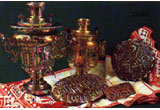
In 1702 Peter the Great awarded the famous Tula smith Nikita Demidov with land in the Ural Mountains where rich metal deposits were found. Thanks to the Demidov dynasty, Tula and the Urals became famous for all types of metal works, as it still is to this day. It's unique metal incrustation works are sought after by collectors. Siberian hunters still use weapons from the 275-year-old Tulsky oruzeinii zavod (Tula weapons factory). All Russians know that Tula produced the first samovar and, to this day, makes the best and most desired ones. It would be unfair not to mention that Tula is the city where the world-famous semi-automatic AK-47 was designed and tested by Mr. Kalashnikov. The AK-47 and its further modifications as well as ancient weapons of the Ghengis Khan era can be seen in Russia's only museum of weapons - located in the 300-year-old Tula Kremlin.
The mid-sized city remains to this day a historic, cultural, scientific and provincial center known for innovation. In 1930, Tula State University was founded to harness the creative power of the people in fields ranging from weaponry and optics to agriculture and the humanities. This ancient city, which dates to at least 1146 and has the ancient churches and Kremlin to prove it, remains to this day a center for Russian scientific and intellectual advancement.
www.sras.org