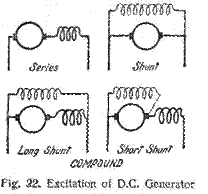
 Excitation of the
Field Windings. — There are several methods for the excitation of the
field magnets, and the behaviour of the dynamo on load is governed by
the method adopted. The three usual methods are known as (a) series, (b)
shunt, and (c) compound excitation, the connections being indicated
diagrammatically in Fig. 22. In the series dynamo the armature, field
winding, and load are all connected electrically in series so that all
are traversed by the same current. The
field
winding has "thus to carry the full armature current, and the conductors
of which it is composed must be of sufficiently large cross section to
carry this current without overheating. The necessary magnetic flux per
pole to induce a given e.m.f. in the armature depends upon the
ampere-turns of the field, that is, the product of the number of field
turns into the exciting current. Since the field winding of the series
dynamo carries the full armature current, the number of field turns is
small compared with other methods of excitation.
Excitation of the
Field Windings. — There are several methods for the excitation of the
field magnets, and the behaviour of the dynamo on load is governed by
the method adopted. The three usual methods are known as (a) series, (b)
shunt, and (c) compound excitation, the connections being indicated
diagrammatically in Fig. 22. In the series dynamo the armature, field
winding, and load are all connected electrically in series so that all
are traversed by the same current. The
field
winding has "thus to carry the full armature current, and the conductors
of which it is composed must be of sufficiently large cross section to
carry this current without overheating. The necessary magnetic flux per
pole to induce a given e.m.f. in the armature depends upon the
ampere-turns of the field, that is, the product of the number of field
turns into the exciting current. Since the field winding of the series
dynamo carries the full armature current, the number of field turns is
small compared with other methods of excitation.
In the shunt dynamo the field winding has a very high resistance compared with that of the armature, the exciting current being small compared with the full-load armature current. The winding therefore consists of a large number of turns of wire of small cross section.
The compound dynamo has both series and shunt excitation acting together. The series coil carries the current supplied to the external load, while the shunt coil carries only a small current as in the plain shunt dynamo. It will be seen from Fig. 22 that there are two alternative methods of connection for the compound dynamo. In the "short shunt" the shunt winding is connected directly across the brushes, while in the "long shunt" it is connected across the machine terminals.
М.А. Беляева и др. «Сборник технических текстов на англ. языке»