 Electrostatic effects are found to be
usually characterized by very large potentials or voltages accompanied
either by small currents or by currents that last for a very short time.
A spark lasts less than one-tenth of a second and sometimes as little a
time as a millionth of a second. However, two large spheres separated by
a distance of one centimeter have to be charged to a potential
difference of 30,000 V, at least, before the electrical intensity is
sufficient to force a spark through the air resistance. If the spheres
are separated by a distance of, say 40 cm, the potential difference must
be nearly a million volts, only then will a spark pass.
Electrostatic effects are found to be
usually characterized by very large potentials or voltages accompanied
either by small currents or by currents that last for a very short time.
A spark lasts less than one-tenth of a second and sometimes as little a
time as a millionth of a second. However, two large spheres separated by
a distance of one centimeter have to be charged to a potential
difference of 30,000 V, at least, before the electrical intensity is
sufficient to force a spark through the air resistance. If the spheres
are separated by a distance of, say 40 cm, the potential difference must
be nearly a million volts, only then will a spark pass.
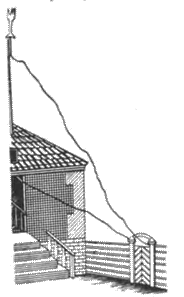
All know at present, that lightning is a gigantic electric spark between charged clouds or between a charged cloud and the ground. However, there was a time when lightning was a subject for legends, an insoluble problem that scientists vainly tried to explain.
Benjamin Franklin, the great American scientist and progressive statesman, is acknowledged to be the pioneer of the theory of atmospheric electricity. In 1752, at Philadelphia, he flew a kite to draw down the lightning from the clouds to the earth and prove it to be electricity. In his famous kite experiment, he demonstrated that atmospheric electricity and static electricity is one and the same thing. And it was he, too, who was the first find the ingenious defense against the destructive action of lightning, — the lightning rod. Franklin was not only an outstanding scientist but also a true friend of the people. He has always been highly appreciated in Russia.
Franklin's achievements were analyzed and approved by Lomonosov who had made his own experiments independently.
The idea of atmospheric electricity greatly interested both Lomonosov and his friend Professor Rihman. Both of them are reported to have made systematic observations and experiments on the subject in question. We know Rihman to have constructed for that purpose the first electrical measuring instrument in the world. However, to carry on investigations of such a kind was more than dangerous in those times. Indeed, Rihman was killed by a stroke of lightning during one of his experiments.