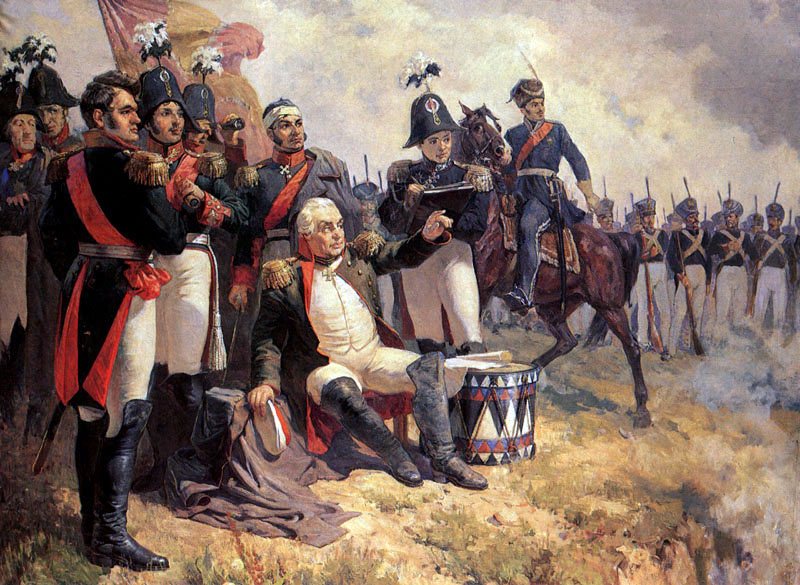
 The Borodino Museum and Nature Preserve is
the oldest of Russia's museums, founded on a historical battleground. It
became famous following the largest battle in the Patriotic War of 1 81 2.
It was at Borodino that the Russian Army, led by Field Marshal Mikhail
Kutuzov, went into fierce combat against the invading "Great Army" of
Emperor Napoleon Bonaparte. The battle went on for 15 hours, with about
300,000 men and 1,200 guns in action on both sides.
The Borodino Museum and Nature Preserve is
the oldest of Russia's museums, founded on a historical battleground. It
became famous following the largest battle in the Patriotic War of 1 81 2.
It was at Borodino that the Russian Army, led by Field Marshal Mikhail
Kutuzov, went into fierce combat against the invading "Great Army" of
Emperor Napoleon Bonaparte. The battle went on for 15 hours, with about
300,000 men and 1,200 guns in action on both sides.
In his offensive, the invincible Napoleon failed to overcome the resistance of the Russians. The staunchness and self-sacrifice of the defending troops turned out to be stronger than the furious courage of the invaders. Mikhail Kutuzov referred to the battle as an everlasting monument to the fortitude and outstanding bravery of the Russian warriors, while Napoleon referred to it as a battle of the giants. The day of the battle, August 26, 1812, gave birth to what is now known as the battlefield of Borodino, the principal "exhibit" of the present day Borodino Museum and Nature Preserve.
The year 1839 became a significant landmark in the history of the museum. On August 26, 1839, in Emperor Nicholas I's presence, in front of the 1 50,000-strong troop formations and 200 veterans of the battle, on the top of a barrow where one of the main fortifications of the Russian army had been located (the battery of General Rayevsky), a memorial was sanctified to commemorate the valiant Russian warriors. The remains of General Bagration, who had died a hero's death in the Battle of Borodino, were buried nearby. At the foot of the barrow, a lodge was built for war veterans who, from then on, as assigned in the Emperor's decree, would look after the memorial, keep the visitors' book, show visitors the plan of the battle and demonstrate the finds picked up on the battleground. The land within the central part of the battlefield was bought by the Emperor in the name of the Crown Prince, the would be Emperor Alexander II. To host royal visitors and their suite, a small wooden palace was put up in the village of Borodino, whose interior was decorated with the portraits of Russian generals who had fought in the campaigns against Napoleon in 1812-1814. Various relics related to the battle, including the battle maps, were also kept in the palace. All this made up the basis for the future national museum, the first in its kind in Russia.
At the ceremony held on August 26, 1839, one of those present among the guests of honor was the widow of General Tuchkov. Greeting her, the Emperor said: "This is the honorable widow of the brave General Tuchkov, and she has forestalled me by erecting an undying memorial here."
In 1820, Margarita Tuchkova, in memory of the heroes of the Battle of Borodino, had had a church erected on the Bagration fleche lines, where her beloved husband had died, — the Begotten Saviour Church. In 1838, the Borodino Convent of the Saviour was opened at the very same spot, with Margarita Tuchkova, now Mother Maria, serving as the mother superior at the convent. After she died in 1 852, everything in her house was to remain intact, with the blessing of Archbishop Philaret, Metropolitan of Moscow.
During the decades that followed, Borodino continued to be a focus of considerable public interest. The place would be visited by members of the royal family, high-ranking state officials, military commanders, Orthodox pilgrims and the progeny of the warriors of 1812. Amongst theses, there were many who wished to communicate their impressions and thoughts about the place, write about it in their memoirs or show it in works of art. Suffice it to list here such well-known names as Pyotr Vyazemsky, Vasily Zhukovsky, Nikolay Gogol, Alexandre Dumas, Vasily Vereshchagin.
The officers of Borodino Railway Station, on their own initiative, set up a Museum of 1812 in one of the station's rooms in 1903.
In 1912, the country commemorated the centenary of the Patriotic War against Napoleon, which led to a new wave of interest in the place by state officials, the public and the military. The principal commemorative ceremonies were held on the battlefield of Borodino.
Individual military units and formations, such as regiments, divisions, artillery brigades and corps, were allowed to put up memorials of their forebears, who had fought at Borodino, using their own funds. Special memorials were set up to mark the command posts of Mikhail Kutuzov and Napoleon.
Under the guidance of officers from the General Staff, the main field fortifications were restored back to their original 1812 state. The battlefield of Borodino came to be seen as a military and historical monument whose value was both memorial and academic. The commemorative ceremonies, attended by Emperor Nicholas II, began on August 25, 1912, with a church procession going in front of the troop formations onto the field — "in memory of the church procession that took place on the eve of the Battle of Borodino." Next day, a thanksgiving service was held at the Rayevsky Battery, attended by the Emperor, Nicholas II, and the royal family. Then there was a military parade during which commemorative medals, books and gifts were handed out.
The radical political transformations of 191 7 also led to 'revolutionary' changes on the battleground of Borodino. In the early 1920s the emperor's palace was turned into a hospital, while some items from its collection were removed to the museum building at the Rayevsky Battery. The exhibits from the closed museum at Borodino Railway Station were taken to the same place. The museum of Borodino battlefield was turned into a subsidiary of the Military Historical Museum.
The most gloomy times in the museum's history came in the 1930s. It was in that period that the Soviet authorities were especially active in destroying and defiling churches, memorials, tombs, icons. The slogan painted on the walls of the closed down Borodino Convent of the Saviour ran as follows: "No more of this hangover from the slaves' past!" In 1932, they dismantled the memorial at the Rayevsky Battery, and devastated the tomb of Bagration. They took off the symbols of Russian statehood — the two-headed eagles, crowns, cross — from nearly all the monuments and memorials throughout the battleground.
During World War II, in October 1941, the battlefield of Borodino was once again a fierce combat ground: for six days Russian ground forces were holding off the German offensive thrusting towards Moscow. The artillery fire and bombings ruined some of the memorials and monuments. The Germans turned the main museum building into a slaughter house; when, later, they retreated, they burned it down. Some buildings at the Convent, including Mother Maria's house, were also devastated by fire. The palace building in the village of Borodino was burned to the ground.
The museum's exhibits, however, were rescued: in October 1941, they were taken first to Moscow, then to Alma-Ata. As early as 1944, a year before the end of the war, the exhibits were once more back in the restored and renovated museum building in the middle of Borodino battlefield. The museum was reopened for visitors.
In 1961, a year before the 150th anniversary of the battle, the Borodino field received the official status of a national museum and nature preserve "embracing all the memorial places and historical monuments of the Borodino battleground".
In the '60s and 70s, most of the memorials and monuments were restored. To the old memorials and monuments were then added the tombs of Soviet soldiers who had died in World War II.
In the '60s and '70s, most of the memorials and monuments were restored. To the old memorials and monuments were then added the tombs of Soviet soldiers who had died in World War II. Granite grave stones were put up at their communal graves. In the middle of the field, in 1971, a tank-based monument to the soldiers of the Fifth Army was put up. Restoration work was start-ed in the buildings of the former Borodino Convent, into which some sections of the museum moved in the early 1980s.
The principal Battle of Borodino Memorial, at the Rayevsky Battery, was restored in 1987, and in 1995, another old monument, at the Borodino Convent, was reopened: "To the Heroes of Borodino from a Grateful Russia".
In 1994, the Federal Government of Russia specified the area and boundaries of the national museum and preserve. At present, the area of the museum with about 300 memorial objects is 109.7 sq km, while the protective zone is as large as 645 sq km.
The museum's collections have more than 50,000 exhibits. Among its rarities there are some personal belongings of Emperor Alexander I, Field Marshal Kutuzov and other Russian and foreign commanders, trophies from Napoleon's transport, the documents and regalia of the Soviet commanders and soldiers who defended Moscow in 1941-42.
A kilometer away from the main museum building lays the building of the Borodino Convent of the Saviour. The great Russian writer, Leo Tolstoy, stayed in the inn of the convent in September 1 867. Now the former inn houses the exhibition "Leo Tolstoy and the Battle of Borodino". The visual exhibits dating up to the 1860s allow visitors to see the battleground of Borodino the way Tolstoy could see it at the time.
The exhibition displays some of the books (historical works, memoirs, fiction) which Tolstoy used when writing his famous War and Peace. Of special interest are the original draft notes made by the writer on the Borodino battlefield, which he later used to make changes in the final version of his description of the Battle of Borodino.
The Museum House of Mother Maria and its interiors have been restored, based on old photographs and descriptions. The most fascinating exhibits are a few of the nun's belongings that have been miraculously preserved: a carved wooden cross, a silver enamel-covered ring, a small Mother of God Icon. The area of the exhibition is tiny: there are only three small rooms, two of them telling you about the mundane life of Margarita Tuchkova, her husband's heroic conduct in the battle, and how she came to found the convent. The main room in the house was used by the nun as a study as well as a chapel-room.
As in the 19th century, there is now an excursion for pilgrims, centered on a visit to Borodino Convent, restored to its former use since 1 992. The excursion consists of two parts, one being led by the museum's guide. The other part is led by nuns from the convent, telling you about the convent, and about Mother Superior Maria. A pilgrim has the opportunity to take part in services officiated at the convent.
Annually held military-historical events are a very important part of the museum's life. On September's first Sunday, tens of thousands of people will always come to the battleground to celebrate the Day of Borodino. The most fascinating part of the celebration consists in a military-historical game reconstruction of some episodes of the battle, the participants of the game coming not only from all over Russia, but from abroad as well. Having made the old-time uniforms, armaments and equipment with their own hands, and having studied the old-time field manuals, those thousands of amateur experts in military history will play it all out on a march, on a bivouac and in battle.
This year's 190th anniversary of the Battle of Borodino was commemorated on September 7th and 8th in an especially grand way. It began with a divine liturgy and a thanksgiving service, officiated by Metropolitan Juvenaly of Krutitsy and Kolomna in the St. Vladimir Cathedral at Borodino Convent of the Saviour. During the service, the hymn "Eternal memory" was sung to commemorate all those who lost their lives in battle. On the theatre parade ground, at the village of Borodino, military honors were done to the heroes of the Battle of Borodino. The culmination point in the feast came as the participants acted out some episodes of the battle of 1812, and then marched in parade formations. To participate personally in such an action is a tremendous experience. The great tradition developed for several decades still lives on.
Since 1995, the Borodino Battlefield National Museum and Nature Preserve has been on the official list of the most valuable cultural heritage objects of the Russian Federation.
Materials presented by the Borodino Museum and Nature Preserve
(“Moscow today and tomorrow” October. 2002)