|
Those evening bells! Those evening bells! How many a tale their music tells, Of youth and home, and that sweet time, When last I heard their soothing chime! And so 't will be when I'm gone; That tuneful peal will still ring on, While other bards shall walk these dells, And sing your praise, sweet evening bells!
Thomas Moore
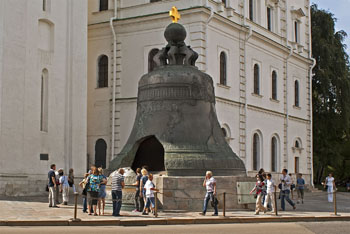
The tuneful peal of Ivan the Great Bell-Tower symbolizes Russia for millions of people both in our country and abroad. It rises above Cathedral Square in the very heart of the Kremlin. Mystery surrounds the origin of the belfry's name. According to one theory, the belfry was named after the original church of St John Climactus or St John of the Ladder (John is Ivan in Russian) erected in the 14th century in the reign of Ivan Kalita. Other theories are that Ivan the Great Bell-Tower got its name after Ivan I (Kalita), Ivan III, or Ivan IV (the Terrible) - the Grand Princes of Moscow who did so much to free Russia from the Tartar yoke and to strengthen the Russian state. The construction of the first three tiers was completed (1505- 508) under the supervision of the Italian architect Bon Fryazin and the epithet great was added to denote the great height. True, initially, the belfry's total height was 60 metres. It was the tallest structure in both Moscow and Europe and a hundred years later two more tiers and three hundred square-metre gilded domes were added, bringing the total height up to eighty-one metres (265 feet). The gilded inscription beneath its cupola tells us that the building was fulfilled in the reign of Boris Godunov. Since then the Bell-Tower of Ivan the Great has become a symbol of spiritual prayer rising high up to the sky, burning like a candle to the Lord. Between 1532 and 1543 the architect Petroch the Younger built a rectangular tower on the north side of the belfry. A 16-ton bell, called the Annunciation Bell, was hung in the belfry. In 1624, the so-called Tower of Filaret was built on to this second building's north end. The unforgettable melody of Ivan the Great Tower bells is well known all over the world. Though the impressive structure may be associated with the names ofMoscovy's Grand Princes and Russian tsars, they were not the true creators. The true ones were craftsmen, stone masons, carpenters and foundry men... If only bells could tell us stories, we would be surprised to hear the thrilling narrations of the 21 bells. We should take into consideration that misfortune would often overtake one bell or another. They either broke or cracked and melted. As for the Kremlin set of bells, it is, in its way, unique, as each one represents an original work of artistic casting, while some of the larger bells will hardly be found anywhere else. In the centre of the belfry hangs the biggest bell of all, the Dormition Bell, weighing 64 tons which was cast by the craftsmen Zavyalov and Rusinov in 1817 in honour of the victory won over Napoleon. Another bell, the Reut, a 32-ton mammoth, was cast (in 1622) by the noted Andrei Chokhov, who throughout his long life produced numerous large bells and cannons both for the Kremlin and the Holy Trinity Monastery of St Sergius, including the fantastic Tsar-Cannon. During its long life the Reut fell twice: in 1812 when Napoleon blew up the belfry and in 1855 during a church service making the coronation of Emperor Alexander II. You may believe it or not but it was not damaged. There are a lot of names in the history of Russia which overgrew the chronological boundaries of the epochs. Among them we can't help recollecting the names of the celebrated 17th-century foundrymen Ivan and Mikhail Motorin, who cast the world's biggest Tsar-Bell. For centuries people have been looking at it with admiration and astonishment. It is unequal in size and decoration. The bell itself weighs 200 tons, while the fragment resting on the ground alone weighs 11,5 tons. It is 20 feet high and 21 feet in diametre. It took four years to prepare drawings and build four furnaces and a ten-metre-deep foundry pit, but only 36 minutes to pour the metal into the mould. Troubles undermined Ivan's health and he suddenly died, but his son Mikhail succeeded in completing the job. Embossing was started in the summer of 1736 but couldn't be brought to a successful finish. In 1737, when the bell was still in the casting pit, a devastating fire broke out in the Kremlin. In the course of fighting it, some water went on to the red-hot bell causing it to crack and a piece of it to fall out. It was not the end of its rather unusual history. The damaged bell lay in its foundry pit for another one hundred years, as all advanced projects to lift it out of the pit were unreliable. Thanks to the genius of the outstanding architect and engineer Auguste Montferrand who built St Isaac's in St Petersburg, the bell was raised from its casting pit by means of a special mechanism of his own design and placed upon the platform where it is to be seen today. The surface of the bell has fine relief work and bears five icons and two inscriptions describing the history of its casting. At the turn of the seventeenth and eighteenth centuries the bells were often imported to Moscow from Holland by sea via Archangelsk, but 35 years later, visitors from Europe were seized in real delight looking at an exclusive engineering feat of Russian foundrymen. Centuries have passed. But during the great church feasts the Kremlin Bells are still ringing and calling us for mutual understanding, purity of soul and true love. Those Kremlin bells! Those Kremlin bells! How many a tale their music tells...
T.Yakovleva Speak Out 2-3 1997 |
 Have you ever heard the Kremlin Bells
ring?
Have you ever heard the Kremlin Bells
ring?