|
The Kuskovo Country Estate, a unique monument of 18th-century culture, was set up as a summer residence for the Sheremetev counts to hold elegant receptions and theatrical festivals. The Sheremetev family was one of the most remarkable and wealthy of the Russian nobility of the 18th and 19th centuries. Especially well known in the mid-1700s was Count,Peter Sheremetev, owner of colossal land holdings and numerous estates, including Ostankino and Kuskovo, the famed Podmoskovnye, or suburban, residences located outside the then city limits of Moscow. The serfs owned by the Sheremetevs numbered almost 400,000 — enough to populate a small country. Among these were talented and able craftsmen, skilled in such crafts as stone masonry, carpentry, painting, woodwork and architecture. Some, among them the Argunov family, found their place amongst Russia's most celebrated artists. Count Peter Sheremetev was an educated man with exquisite tastes who loved art and the theatre. He transformed his Kuskovo estate into a corner of paradise, where he collected unusual amusements, much in keeping with typical 18th-century aristocratic customs. There he organized numerous events frequently attended by royalty such as Emperor Joseph of Austria and Catherine the Great, Empress of Russia. These parties became famous for their dazzling firework displays, and marvellous dinners, which were served to the guests on trays made of solid gold. The opulent house in Kuskovo was built by the French architect de Vally. The interior was lined with Venetian mirrors, and decorated with expensive French furniture, crystal chandeliers, parquet floors made of precious woods, and hung with priceless works of art and rare tapestries. The walls were graced by a collection of paintings by Raphael, van Dyck, Correggio, Veronese, and Rembrandt. The huge library held a collection of works by the greatest writers of the ancient and modern worlds, in six languages. The entire second floor was taken up by an armoury, the pride of the Sheremetev family. Stored here were extremely rare weapons: sabres embellished with gold; daggers decorated with precious stones ancient broadswords; rifles inlaid with silver and encrusted with mother-of-pearl and riding apparel, including the saddle which had belonged to King Charles XII of Sweden. Adjoining the palace was an enormous park, which turned into a forest. The park was crisscrossed by canals spanned by charming little bridges. Seventeen ponds freshened the air at Kuskovo, and in the evenings engulfed it in a romantic mist. The garden was decorated with statues and rare flowers. Especially outstanding were statues entitled "Morning", "Noon", "Evening", and "Night", which were installed so artfully that the sun shone on them at the appropriate times of day, while "Night" remained unlit. The largest of the ponds boasted a flotilla of rowing and sailing boats. A visitor to Kuskovo could walk around the estate for hours and hours, and constantly discover enchanting new sights and amusements. The Dutch pavilion was decorated with blue tiles and paintings by Dutch masters, and surrounded by a Dutch garden with a pool and a grill-work fence. The Italian house had its own garden, as well as a fountain. A carillon rang out from the Chinese tower. By the side of the octagonal pool stood a marble grotto whose walls were inlaid with sea shells and mother-of-pearl. Another part of the park held the two-storey Hermitage, for entertaining close friends. Here there were no staircases inside; the only way to get to the second floor being by means of a velvet divan, which served as an elevator. In the centre of the great hall upstairs was a round table which seated 16 guests. At a signal from a special bell, the table was lowered, then raised again, fully set with steaming dishes, and wines in carafes. Walking through the park, one might hap upon a labyrinth of thorny bushes surrounding the Temple of Silence; or look into the Lion's den, a cave in which a marble lion lay sleeping on a bed of laurel wreaths; or espy a haystack, which, on closer inspection, turned out to be a secret pavilion with upholstered furniture, hung with mirrors, and decorated in the style of Boucher. In the heart of the forest stood the Philosopher's house; above the entrance hung a sign in two languages, French and Russian, which proclaimed, "Pay no attention to honours that do not make a man better or wiser." Nearby stood the Chaumier (hut, in French) pavilion, with a thatched roof. A glance in the window revealed a group of people seated around an abundantly set table, but on closer inspection, the guests and the appetizing dishes turned out to be made of wax. Besides the pavilions, the park also boasted hothouses, fountains, and a zoo well stocked with bears, moose, foxes, deer, and an aviary containing rare species of birds such as cranes, pelicans, swans, pheasants, and Canadian geese. Lighthouses, ancient ruins, draw-bridges, and a summer dance concourse were scattered about the grounds. There was a Greenery theatre with grass benches, and an amphitheatre of trimmed bushes, with amazing acoustics. And finally, there was a real theatre, with three tiers of gilded boxes and a large stage equipped with up-to-date machinery, where the most technically demanding shows could be performed. Count Peter Sheremetev was an inveterate lover of the theatre. His troupe of serfs, consisting of actors of the stage, ballet dancers, opera singers and musicians, soon became serious competition for the professional theatrical groups. His serf poets and serf composers wrote operas and ballets; serf artists designed the sets and costumes, finished in velvet and brocade by the theatre's own tailors and dressmakers. It was just at this time that Count Peter's son Nicholas returned from a trip abroad. Already past thirty, wealthy and independent, he was the quintessential 17th-century playboy, whose passions included hunting, horses, and, of course, women. Nicholas attended one performance at his father's serf theatre, and the impossible happened: he fell head over heels in love with the leading actress, Praskovia Kovalyova, and immediately realized that he could not live without the daughter of the Kuskovo blacksmith. Though Praskovia Kovalyova could not be described as a great beauty, she was tall, had a lithe figure, refined manners, a graceful walk, an imperfect but interesting face, and lively black eyes. She was also gifted with intelligence and an inborn sense of tact, was widely educated though self-taught, and could converse on many subjects. Last but not least, she had unbounded charm. When he fell in love with his own serf, Count Nicholas changed noticeably: he renounced his former passions, forgot about hunting, gave up his hedonistic lifestyle, involved himself in household matters, and became a philanthropist. In 1 786, his father died, and Count Nicholas Sheremetev became sole owner of the colossal Sheremetev fortune, a substantial part of which he invested into the theatre at Kuskovo. His beloved Praskovia continued to distinguish herself on the stage, but the difference in social standing between the count and his lover was too great in the eyes of society, and he found he could not marry her. Simultaneously, the count's bachelor status began to arouse disapproval in the court. Praskovia came down with tuberculosis. Doctors gave her but a few years to live, and in November 1801, Count Sheremetev, ignoring public opinion, decided to marry his beloved in Moscow in a secret ceremony. On February 3, 1803, their son Dmitry was born, and three weeks later, Countess Sheremeteva died. The count outlived his wife by six years, consumed by grief for his loss. In loving memory of his wife, he gave away large sums of money to orphans and to the poor. In Moscow, he built a home for the indigent, with an adjoining hospital and an almshouse. It is still a hospital to this day. His favourite estate was eventually abandoned. The works of art and wild animals were carted off to other properties and to the Sheremetev home in St. Petersburg. The theatre was boarded up and forgotten. Nevertheless even today Kuskovo, long a Moscow landmark, gives a perfect picture of the life of 17th century aristocracy. The Dutch and Italian pavilions are still standing, as are the hothouse, grotto, Hermitage, and the obelisks which were erected in honour of the Catherine the Great's visit. In 1919 the Kuskovo estate was turned into a museum. Twenty years later, it became the home of the Museum of Ceramics, adding yet another elegant feature to the park that held memories of an outstanding serf actress. The Museum of Ceramics is quite unique. Nowhere else in the world can one find over 25,000 elegant pieces executed in porcelain and glass. The heart of the Kuskovo collection was put together by Alexey Morozov, an avid collector of Russian porcelain. The great stone hothouse exhibits true masterpieces, including several works dated 1748, by Dmitry Vinogradov, the originator of the Russian porcelain industry. Here also is the famed Egyptian dinner service, made in Sevres expressly for Napoleon I, who presented it to Emperor Alexander I. There is also a Venetian majolica, several items from the Royal Copenhagen Factory, and the works of famed English factories.
by Alya Kaplun (“Moscow today & tomorrow”. December / 2002)
|
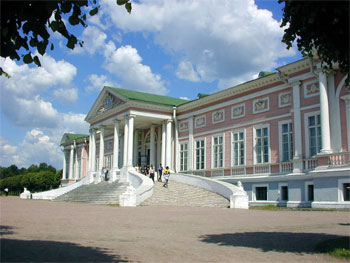 We so often
travel to other places and countries to see the wonders of past
times and the lost traditions miraculously retained despite the flow
of time. To plunge into the atmosphere of the gallant and splendid
18th century, however, you need not travel to St. Petersburg or
Paris. Coming to Moscow's Kuskovo Museum Estate suffices. Time's ebb
and flow, charmed by this place's beauty, must have slowed down its
pace. Modern living quarters, with high buildings, have risen some
distance away, but they retreat respectfully from such an ancient
architectural masterpiece. Kuskovo is fine in any season. The park
is especially pleasant in winter. Taking a leisurely stroll along
the avenues, covered with dazzling white snow, and past the elegant
pavilions, marble statues and pale pink magnificent palace, the
surrounding quiet bestows calm and peace to one's soul
We so often
travel to other places and countries to see the wonders of past
times and the lost traditions miraculously retained despite the flow
of time. To plunge into the atmosphere of the gallant and splendid
18th century, however, you need not travel to St. Petersburg or
Paris. Coming to Moscow's Kuskovo Museum Estate suffices. Time's ebb
and flow, charmed by this place's beauty, must have slowed down its
pace. Modern living quarters, with high buildings, have risen some
distance away, but they retreat respectfully from such an ancient
architectural masterpiece. Kuskovo is fine in any season. The park
is especially pleasant in winter. Taking a leisurely stroll along
the avenues, covered with dazzling white snow, and past the elegant
pavilions, marble statues and pale pink magnificent palace, the
surrounding quiet bestows calm and peace to one's soul