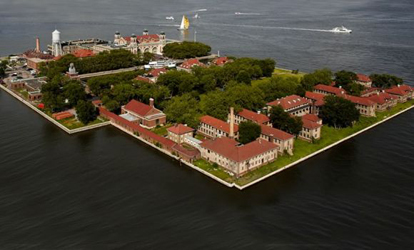
 Before
they could begin their new life, immigrants to New York had to stop on Ellis
Island. Between
1892
and
1954,
this place was the
gateway to the US for almost
17
million
new Americans.
Before
they could begin their new life, immigrants to New York had to stop on Ellis
Island. Between
1892
and
1954,
this place was the
gateway to the US for almost
17
million
new Americans.
Ellis Island did not just welcome new Americans. The officers there also decided who could not come into the US. New immigrants stood at last on American land. But the big question was this: Could they stay?
Most people took between two and five hours to pass through Ellis Island. In the station's early years, immigrants had to complete these tests:
Ellis Island did not just welcome new Americans. The officers there also decided who could not come into the US. New immigrants stood at last on American land. But the big question was this: Could they stay?
Most people took between two and five hours to pass through Ellis Island. In the station's early years, immigrants had to complete these tests:
• First, they answered 29 questions. (How old were they? What job did they do in their old country? Were they married? Could they read?)
• Then immigrants were sent to the second floor of the building. This was the second test. Doctors watched people as they walked up the stairs. If they were not healthy, they had to have more tests. Very sick people were sent back home.
• Immigrants were then asked the same 29 questions again. Were their answers the same as the first time?
After this last test, immigrants were free to go into the country. Information was kept about everyone. Often immigrants changed their names, wanting to make them more "American." They could change money for US dollars. Then they could begin their new life. Some bought a train ticket all the way to California. Others decided to take the ferry and make New York their home. In this big, busy city they could find jobs. But life was not always easy. Many people in the city were very poor. Many immigrants could only live in cheap, dark, dirty buildings. These "tenements" were too hot in the summer and too cold in the winter.
Money Talks
Ellis Island was not always fair in the early years. For some immigrants, their first day in the US taught them an important lesson ... about money.
• Most immigrants arrived by boat. On some boats first and second class passengers were checked and let into the city. The other passengers had to go to Ellis Island.
• Sometimes Ellis Island workers took money from immigrants.
• When immigrants bought American dollars, they did not always get a fair price.
• The trains sometimes had high prices for tickets only for people from Ellis Island.
But in 1901, President Theodore Roosevelt learned about the problems at Ellis Island. After that, things became better.
After Ellis Island closed, the buildings were empty for years. But in 1990, they were opened as a museum. Tourists can take the same ferry to Liberty Island and to Ellis Island. The museum at Ellis Island really tells the story of the people of the United States.
Many Americans come here, too. Often they want to learn more about their family history. More and more of Ellis Island's old information is on computer now. People can easily see how their relatives answered the questions. They can find out what their relatives brought with them for their new life in the US.