 Harlem
is a large neighborhood within the northern section of the New York City borough
of Manhattan. Since the 1920s, Harlem has been known as a major African-American
residential, cultural and business center. Originally a Dutch village, formally
organized in 1658, it is named after the city of Haarlem in the Netherlands.
Harlem's history has been defined by a series of economic boom-and-bust cycles,
with significant population shifts accompanying each cycle.
Harlem
is a large neighborhood within the northern section of the New York City borough
of Manhattan. Since the 1920s, Harlem has been known as a major African-American
residential, cultural and business center. Originally a Dutch village, formally
organized in 1658, it is named after the city of Haarlem in the Netherlands.
Harlem's history has been defined by a series of economic boom-and-bust cycles,
with significant population shifts accompanying each cycle.
African-American residents began to arrive en masse in 1905, with numbers
fed by the Great Migration. In the 1920s and 1930s, Central and West Harlem were
the focus of the "Harlem Renaissance", an outpouring of artistic work without
precedent in the American black community. However, with job losses in the time
of the Great Depression and the deindustrialization of New York City after World
War II, rates of crime and poverty increased significantly.
Since New York City's revival in the late 20th century, Harlem has been
experiencing social and economic gentrification. However, Harlem still suffers
from many social problems. Large portions of the population receive a form of
income support from the government—with West, Central, and East Harlem
respectively at 34.9%, 43.3%, and 46.5% of the population.
Harlem's black population peaked in the 1950s. In 2008, the Census found
that for the first time Harlem's population was no longer a majority black, with
their share being 4 in 10 residents.
In the 1920s and 1930s, Central and West Harlem was the
focus of the "Harlem Renaissance", an outpouring of artistic work without
precedent in the American black community.
Though Harlem musicians and writers are particularly
well remembered, the community has also hosted numerous actors and theater
companies, including the New Heritage Repertory Theater, National
Black Theater, Lafayette Players, Harlem Suitcase Theater, The Negro
Playwrights, American Negro Theater,
and the Rose McClendon Players.
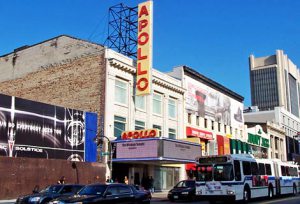
The Apollo
Theater opened on 125th Street on
January 26, 1934, in a former burlesque
house. The Savoy Ballroom, on Lenox
Avenue, was a renowned venue forswing dancing,
and was immortalized in a popular song of the era, "Stompin' At The Savoy". In
the 1920s and 1930s, between Lenox and Seventh
Avenues in central Harlem, over 125
entertainment places operated, including speakeasies,
cellars, lounges, cafes, taverns, supper clubs, rib joints, theaters, dance
halls, and bars and grills. 133rd
Street, known as "Swing Street", became known for its cabarets, speakeasies and
jazz scene during the Prohibition era, and was dubbed "Jungle Alley" because of
"inter-racial mingling" on the street. Some
jazz venues, including most famously the Cotton
Club, where Duke Ellington played,
and Connie's Inn, were restricted to whites only. Others were integrated,
including the Renaissance Ballroom and
the Savoy Ballroom.
Harlem is currently experiencing a gourmet renaissance with new dining hotspots popping up uptown around Frederick Douglass Boulevard. At the same time, some residents are fighting back against the powerful waves of gentrification the neighborhood is experiencing. On October 17, 2013, residents staged a sidewalksit-in to protest a five-days-a-week farmers market that would shut down Macombs Place at 150th Street.