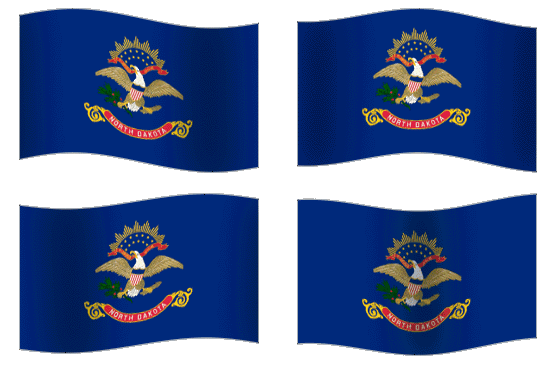
Its motto: Liberty and Union, Now and Forever, One and Inseparable.
Its nicknames: Flickertail State, Land of the Dakotas, Peace Garden State, Sioux State.
Fields of Grain on the Windswept Plains
North Dakota's best-known landscape may be the mysterious badlands, but lush fields of wheat and sunflowers are far more characteristic of this mid-western outpost. Farming is the mainstay of North Dakota. The state is the most rural in the nation, with only four cities — Fargo, Grand Forks, Bismarck, and Minot — having population of more than 20,000.
Until well into the 19th century, the area was inhabited mainly by Indians. In the 1880's, thousands of immigrants, eager to obtain the land offered by the Homestead Act1, arrived in a migration known as The Great Dakota Boom. Norwegians, Germans, and Canadians flocked to the territory and found a level prairie that soon they transformed into a sea of wheat — and became the envy of the nation for their hugely profitable farms.
But the wealth was not easily won. The immigrants found North Dakota winters as bitter as those of their homelands. Efforts by large corporations to monopolize the wheat trade threatened farmers and caused them to band together in populist movements. Perhaps it was the common dependence on wheat that made all men equal.
The settlers brought all three of North Dakota's distinct geographic regions into cultivation. The valley of the Red River of the North is blanketed with fields of sugar beets, potatoes, beans, and more sunflowers than even Kansas grow.
Wheat is also grown in the western portion of the state that lies within the Missouri Plateau. Mineral discoveries here have helped diversify the economy, with lignite mined near Beulah and oil pumped around Williston.
The Missouri Plateau boasts the state's most dramatic scenery:
the badlands. Three separate sections of this extraordinary terrain are now a national park named for Theodore Roosevelt who lived on his North Dakota ranch, Elkhorn, from 26 to 28. This park is a fantastic world of canyons, buttes, and spires that the Little Missouri River, rain, and wind have carved out of the plain.
To call North Dakota's weather extreme is to understate the case. During one year, 1936, the temperature ranged all the way from -60°F to 121°F.
In 1889 North Dakota joined the Union as the 39th state.
(”The USA Diversity of 50 States”)