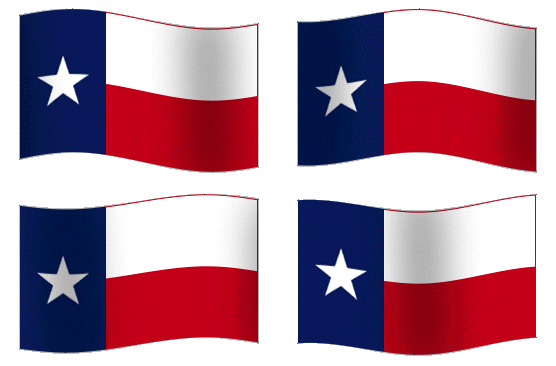
Its motto: Friendship.
Its nickname: Lone Star State.
The Giant State that was once a Nation
Texas encompasses so many regions that it might be a country - and it once was. As a sovereign nation after its separation from Mexico in 1836, Texas was unique among territories admitted to the Union. Also unique was the agreement that it negotiated with the United States: a promise that Texas can, if it chooses, form as many as five new states within its borders.
"Big," the Texan's world-famous brag, is no exaggeration. Texas has two time zones and takes up one-twelfth of the contiguous United States. Its coast on the Gulf of Mexico is the third-longest of any state's, after Florida and California.
The sheer size of Texas explains not only its range of landscapes but also its diversity of plant and animal life. The state supports more than 5,000 species of flowering plants and 100 kinds of cacti. It is also home for mountain lions, ocelots, coyotes, praine dogs, and two of nature's stranger creatures - the horned toad and the armadillo.
The human population is varied as well. Some 26 percent of the state's residents are Hispanic in origin, and many cities are virtually bilingual. This long-standing cultural mix goes by the name of Tex-Mex.
White settlement in Texas took hold in the fertile valleys of the Brazos and Colorado rivers in 1821. Most settlers were farmers, tilling the rich river bottoms and establishing lucrative cotton plantations.
Cotton is still mainstay of the Texas economy, blanketing much of the flat black land in the eastern half of the state. Interspersed with fields of alfalfa and sweet potatoes, cotton fields stretch up to the dense Piney Woods along the Louisiana border, an area where the main industry is logging.
With its forests and farmland, East Texas has more in common with the Deep South than it does with the Southwest.
Another distinct region exists in south-central Texas. After the flatness of East Texas, the Hill Country comes as a surprise. Rocky, juniper-cloaked hills are cut through by clear green rivers. Also unexpected is the Hill Country's German character. German immigrants established the town of New Braunfels in 1845 and later moved west to found the hamlets that thrive in the area today.
Beyond the Hill Country, Texas belongs to the arid West. Cedars melt into mesquite, the mesquite into cactus-covered desert. In the north, cotton fields and farms give way to the vast ranches and wheat fields. Cowboys still work these ranches, some of which are hundreds of thousands of acres in size.
Southernmost of these mountains are the Chisos, which Spanish explorers considered hopelessly inhospitable.
From the dramatic western landscape to the fertile fields of the east, one common factor has united the huge state - oil. When the first gusher blew in at Spindleton in 1901, the Texas oil boom was born, and today there is not a county without a history of oil exploration.
Oil, cotton, and cattle created Texas and the outsize myths that surround it.
In 1845 Texas entered the Union as the 28th state.
(”The USA Diversity of 50 States”)